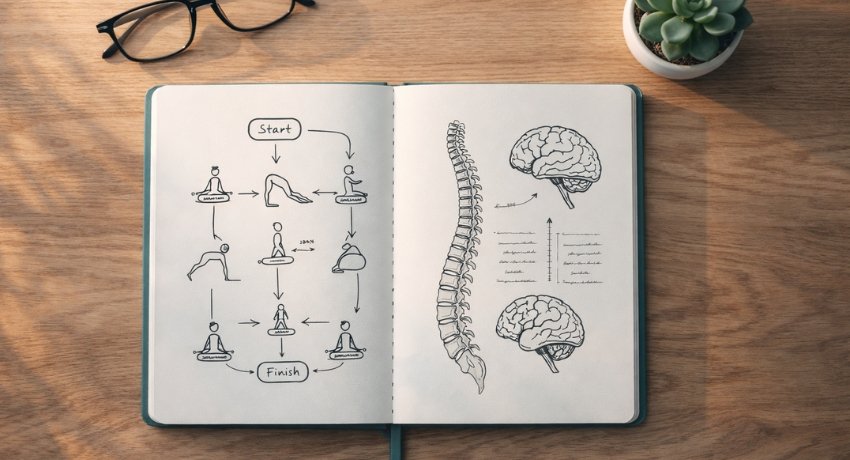
Most yoga teachers don’t struggle with what to teach. They struggle with how to put it together — coherently, safely, and in a way that actually transforms the people in the room.
You have twenty poses you love. A theme that feels alive. A playlist that sets the tone perfectly. And then you sit down to build the class and forty minutes evaporate before you’ve committed a single sequence to paper. Sound familiar?
This is one of the most quietly exhausting parts of teaching yoga — not the teaching itself, but the architecture that has to exist before you ever say namaste. And it deserves a smarter approach.
Why Sequencing Feels Harder Than It Should
The modern yoga teacher is navigating something genuinely complex. Students arrive carrying compressed spines from nine hours of screen work, hip flexors shortened by commuting, and nervous systems running on cortisol fumes. They need a class that meets them where they are physically, moves them somewhere useful therapeutically, and leaves them feeling like something real has shifted.
That is not a casual ask. And the pressure to deliver it — consistently, class after class — is one of the primary reasons yoga teachers burn out within their first three years, according to studies on wellness professional attrition in fitness and allied health industries.
The solution is not to care less about sequencing. It is to stop rebuilding the architecture from scratch every time you plan a class.
What 2026 Wellness Research Tells Us About Class Design
The conversation around yoga sequencing has evolved considerably as neuroscience and somatic research have caught up with what traditional yogic texts understood intuitively. Research from institutions including the Yoga Alliance Research Foundation and published work in The Journal of Bodywork and Movement Therapies points to several consistent findings about what makes a yoga session therapeutically effective rather than merely physically active.
Effective sequences are not about maximum variety. They are about intelligent progression — moving the nervous system through predictable stages of activation and release. Studies on parasympathetic activation and yoga practice consistently show that the order in which practices are introduced significantly affects cortisol response and mood outcomes. A class that opens the hips before warming the surrounding musculature, for example, can trigger protective muscle guarding — the body’s involuntary resistance to perceived threat — rather than the release the teacher intended.
Understanding this is the difference between sequencing intuitively and sequencing intelligently. And the second kind can be learned as a framework.
The Five Phases Every Balanced Yoga Class Should Move Through
This is not a rigid formula. It is the structural logic that underlies almost every effective yoga class in every style — from Hatha to Vinyasa to Yin — and once you internalise it, class planning becomes dramatically faster.
Phase 1: Arrival and Nervous System Calibration (2–3 minutes)
The opening of a yoga class is doing more physiological work than most teachers realise. When a student transitions from the outside world into a yoga space — whether in a studio in Vadodara or through a screen at home — their sympathetic nervous system is still active. The first few minutes should not demand strength or flexibility. They should invite breath awareness, grounding, and a gentle shift toward present-moment attention. Supine positions, simple breath observation, or seated centering with an extended exhale all work here because they directly stimulate vagal tone — the physiological gateway to parasympathetic activation.
Phase 2: Warm Mobilisation (5–7 minutes)
This phase warms synovial fluid in major joints, increases local circulation, and prepares the myofascial system for load. Cat-cow variations, seated spinal rotations, and gentle hip circles are not filler. They are prepared at the tissue level. Research in exercise science consistently confirms that mobilisation before loading reduces injury risk and significantly improves range of motion in the subsequent peak poses.
Phase 3: Building and Peak (15–20 minutes)
This is where the thematic and physical heart of the class lives. Standing sequences, strength-building postures, inversions, arm balances — whatever serves the class’s purpose lives here. The key structural principle is progression: work from proximal stability to distal mobility, build heat gradually, and ensure the peak pose has been prepared for, not ambushed.
Phase 4: Integration and Counter-Posing (7–10 minutes)
Every peak pose creates a physical conversation that needs a response. A deep backbend sequence needs a gentle spinal neutralisation. A strong hip opening sequence benefits from an adductor release and a brief return to neutral. This phase is where many newer teachers rush, and it is almost always what students feel in the next 48 hours if it is skipped.
Phase 5: Savasana and Settling (5 minutes minimum)
Neuroscience offers a clear argument for never shortening this phase. During Savasana, the brain consolidates the somatic learning of the session. Theta wave activity — associated with deep relaxation and memory integration — increases measurably during guided relaxation. A class that skips Savasana is a class that leaves the nervous system without a chance to absorb what just happened. Five minutes is the minimum; seven is better.
The 15-Minute Planning Framework
With the five phases understood, class planning becomes pattern recognition rather than creation from scratch. Here is how to structure your planning session:
Minutes 1–3: Identify your peak pose or theme. Work backward. What does the body need to arrive there safely?
Minutes 4–7: Build Phase 2 and 3 by selecting 3–4 poses per phase that logically progress toward the peak. Use anatomical logic: what needs to be warm, open, or activated?
Minutes 8–11: Select your counter poses and integration sequence. Mirror the peak’s demand. If you opened the hip flexors deeply, include a brief hip flexor stabilisation before moving to the floor.
Minutes 12–14: Choose your opening and closing. The beginning should match the nervous system state your students are likely arriving with. The end should land them somewhere genuinely quiet.
Minute 15: Read it back once. Does each phase flow naturally into the next? Does the energy arc make sense — a gradual build, a clear peak, a considered descent?
That is it. A complete, balanced, intelligent class in fifteen minutes.
Why Depth of Training Shapes Sequencing Confidence
There is a version of this framework that can be learned in an afternoon. And there is a version that becomes second nature — something a teacher uses fluidly without consulting notes — and that version only arrives through training that goes deeper than the surface.
Understanding why certain sequences work requires genuine knowledge of anatomy, of the nervous system’s response to different practices, of pranayama’s effect on physiological state, and of the classical structure of yogic teaching that underlies all of this. That knowledge takes time and the right environment to build.
Ritesh Patel’s approach to yoga teacher education is built on precisely this understanding — that effective teaching comes from genuine comprehension, not memorised sequences. Alongside Poonam Patel, the focus has always been on producing teachers who can think, adapt, and teach with real authority. Students learning at the studio in Vadodara or through structured online programs are trained to understand the principles behind practice, not just the practices themselves.
Who This Framework Is For
This sequencing approach is useful for anyone who teaches yoga or is preparing to teach — from those in their first 200-hour training to experienced teachers who want more efficiency and confidence in their planning process. It is equally valuable for yoga practitioners who want to understand the architecture behind effective classes, deepening their own experience as students.
A Final Thought on Structure and Freedom
There is a quiet paradox in sequencing mastery: the more deeply you understand structure, the more freely you can improvise. A jazz musician who has internalised harmonic theory doesn’t think about scales while performing — they move through them instinctively, in service of something alive in the moment.
The best yoga teachers carry something similar. Their sequencing knowledge is so integrated that it becomes invisible — and what their students experience is simply the feeling of a class that made sense, that moved them through something, that left them more whole than when they arrived.
That kind of teaching is worth investing in deeply. And if this framework gives you fifteen minutes back in your planning week, perhaps use them to explore what the next level of your own training could look like.