Why This Question Is Dividing the Yoga World in 2026
Ask ten experienced yoga practitioners whether online classes can replace a live studio room, and you will get ten genuinely different answers — each rooted in real experience, each partially right, and none of them complete.
The debate has intensified as online yoga has matured from a pandemic-era necessity into a permanent feature of the global wellness landscape. Millions of practitioners now do the majority of their yoga through a screen. Thousands of yoga teachers have built entire careers in the online space. And yet, somewhere in almost every serious practitioner’s experience, there is a memory of a particularly full studio, a perfectly sequenced class, a palpable quality of collective stillness in Savasana — and the quiet, persistent sense that whatever that was, it has not quite been recreated on Zoom.
That sense is worth taking seriously. So is the counterpoint.
What Science Actually Says About Group Practice and Shared Physical Space
The feeling of collective energy in a yoga room is not imaginary — it has a physiological basis that research is only now beginning to fully document.
Stephen Porges’ Polyvagal Theory provides perhaps the most compelling framework for understanding why shared physical space affects practice differently from solo or screen-mediated learning. The theory describes a third branch of the autonomic nervous system — the ventral vagal circuit — that is activated through social engagement: through eye contact, facial expression, vocal prosody, and physical proximity to other regulated nervous systems. This co-regulation is a genuine physiological resource. When the nervous system detects safety through the presence of other calm human bodies nearby, it down-regulates more deeply than it can through solo practice.
A 2023 study published in Scientific Reports documented that synchronised group movement — including yoga — produced measurable increases in endorphin release and social bonding markers compared to individual practice of the same movements. The shared physical experience is not simply motivational. It is neurochemically distinct.
This is what online yoga, honestly and structurally, cannot fully replicate.
What Online Yoga Does Better Than Many Studio Classes Are Willing to Admit
Here is where the honest accounting requires equal rigour in the other direction.
The quality of instruction available through a well-designed online programme often exceeds what is available in the nearest local studio — particularly in cities and regions where the yoga market is dominated by fitness-oriented, sequence-heavy classes that have travelled a long distance from the tradition’s depth. A practitioner in a mid-sized Indian city, or in a regional town internationally, may have access through a structured online programme to a quality of classical teaching — rooted in genuine philosophy, anatomy, and therapeutic understanding — that no studio within driving distance can match.
Ritesh Patel’s structured online programme from Vadodara reaches practitioners across India and internationally precisely because the depth of teaching it offers is not uniformly available locally. The classical yogic understanding embedded in that curriculum — the integration of Patanjali’s philosophy, nervous system science, and authentic asana methodology — travels through a screen without diminishment when the delivery is live, interactive, and genuinely mentored.
Access to depth is not a consolation prize for online learners. For many, it is the actual reason they are there.
How the Best Online Yoga Environments Partially Bridge the Co-Regulation Gap
The honest question is not whether online yoga is identical to in-person practice — it is not — but whether the gap can be meaningfully narrowed by thoughtful design.
The research on synchronous versus asynchronous online learning in somatic disciplines is instructive here. Studies comparing live-streamed classes, pre-recorded classes, and in-person instruction consistently show that the live format captures far more of the relational and co-regulatory benefit than recorded content does. Eye contact through a camera, real-time verbal feedback, the sense of breathing together in shared time even across different physical spaces — these are not nothing. They are partial bridges.
The critical variables are class size and the quality of teacher attention. A live online class of sixty students where the teacher cannot meaningfully see or respond to individuals reproduces none of the co-regulatory benefit of in-person practice. A live online session of eight to twelve students with a teacher whose attention is genuinely distributed — who notices when a student’s breath has gone shallow, who adapts the session in real time — creates something qualitatively different. Not the same as a studio. But not as far from it as the pessimists suggest.
Poonam Patel’s emphasis within the LifeSpring Yoga online programme on genuine individual attention — on making every student visible rather than managing a broadcast — reflects exactly this understanding. The format serves the practitioner only when the teacher is truly present within it.
What Is Irreplaceable and What That Means for Serious Practitioners
Let us be direct about what cannot be adequately substituted. Physical adjustment — the teacher’s hand on a student’s sacrum in a forward fold, the gentle repositioning of a shoulder in Trikonasana — is a modality of teaching that operates through the nervous system in ways no verbal instruction reaches. The body learns differently through touch. This is not philosophy; it is established in motor neuroscience.
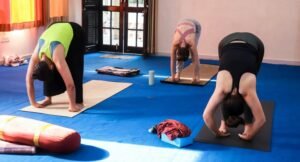
The quality of a room where thirty people have just moved through a deep practice together — the texture of the silence in collective Savasana, the particular quality of breath that fills a well-held space — is a shared somatic experience that exists only in physical co-presence.
For the yoga teacher in training especially, Ritesh Patel has consistently held that the in-person, studio-based learning environment at LifeSpring Yoga in Vadodara offers something that structured online learning can complement but not fully replace — particularly in the supervised teaching practice component, where the immediacy of physical feedback is most consequential.
The most thoughtful practitioners of 2026 are not choosing between these formats. They are building practices that use each for what it does best — online learning for depth of curriculum, consistency, and accessibility; in-person immersion for kinesthetic learning, community, and the irreplaceable quality of shared physical practice.
Who Needs to Think Most Carefully About This Question
This question matters most to serious practitioners deciding how to invest their time and resources in their next stage of learning. To yoga teacher trainees weighing online versus residential training formats. To teachers building programmes and trying to understand what their online students actually need. And to anyone who has practised primarily online and wonders, with genuine curiosity, what they are and are not getting.
What the Energy of a Room Full of Practitioners Actually Is
The collective energy of a full yoga room is real — it is physiological, neurochemical, and relational in ways that deserve genuine respect. Online yoga does not replace it. It offers something different: access, consistency, depth of curriculum, and a quality of teaching that local geography often cannot provide.
Both matter. Neither is the whole story. And the practice that honours this honestly — that seeks immersive in-person experience where it is possible, and the deepest available online instruction where it is not — is the practice most likely to actually transform the person doing it.
That, ultimately, is the only question worth asking.
FAQs
Is online yoga as beneficial as attending a physical class?
For most benefits, yes — but hands-on correction and co-regulation require in-person presence.
What is co-regulation and why does it matter in group yoga?
Co-regulation is nervous system calming through proximity to other regulated bodies — it deepens practice.
Can a yoga teacher build real relationships with students online?
Yes, through small live classes with genuine individual attention rather than large broadcast sessions.
Does online yoga teacher training prepare you as well as in-person training?
A live, mentored online programme comes close — though supervised in-person teaching practice remains essential.
What makes online yoga classes feel energetically flat and how to avoid it?
Answer: Large pre-recorded classes lack live interaction — choose small, synchronous sessions with real teacher attention.