
There is a particular kind of exhaustion that does not arrive suddenly. It accumulates — slowly, unremarkably — across months of early alarms, back-to-back commitments, and the quiet suppression of everything that actually matters to you. And then one morning, usually around the end of April, you sit with your coffee and realise that you cannot remember the last time you did something purely because it made you feel alive.
If you are reading this in May — or approaching it — pay attention to what that timing might mean.
May is the month when India exhales. The long stretch of the academic year is ending. Financial quarters have settled. The heat invites stillness rather than relentless motion. And for many people in the grip of professional burnout or personal stagnation, something instinctive stirs: the sense that now — right now — might be the moment to do the thing they have been quietly postponing.
For thousands of yoga practitioners and wellness seekers across India and globally, that thing is yoga teacher training. And the instinct, it turns out, is well-supported by both science and tradition.
The Burnout Epidemic That Is Driving People Toward Yoga
Burnout is not a personality flaw or a sign of weakness. It is a physiological state — a genuine dysregulation of the body’s stress response systems after prolonged exposure to demands that exceed recovery. The World Health Organization formally recognised burnout as an occupational phenomenon in its International Classification of Diseases, describing it as a syndrome resulting from chronic workplace stress that has not been successfully managed.
In India, this is not an abstract concern. Research from ASSOCHAM and various public health institutions has consistently documented alarming rates of workplace stress and burnout among urban professionals, with the financial, technology, education, and healthcare sectors reporting the highest prevalence. The human cost is significant — disrupted sleep, chronic fatigue, emotional blunting, a creeping loss of meaning in work and relationships.
What makes this particularly relevant to the yoga conversation is what burnout actually does to the nervous system. Sustained stress chronically activates the hypothalamic-pituitary-adrenal axis, producing persistently elevated cortisol levels that, over time, impair immune function, disrupt sleep architecture, and structurally alter the brain’s capacity for emotional regulation. The recovery from burnout is not simply a matter of rest — it requires active, sustained restoration of the nervous system’s baseline.
This is precisely what structured yoga practice, when understood and applied with depth, is designed to do.
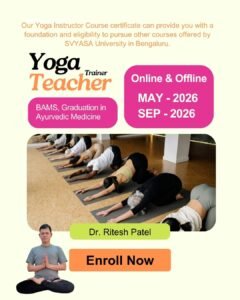
Why the Timing of May Matters More Than Most People Realise
The question of when to begin a significant personal commitment is more important than it is usually given credit for. Behavioural research on habit formation and lifestyle change — including work from the Kellogg School of Management on what researchers call “temporal landmarks” — demonstrates that transitions associated with natural calendar markers produce meaningfully higher rates of follow-through and sustained commitment.
May occupies a particular psychological position in the Indian calendar. It sits at the intersection of endings and beginnings — school years completing, summer holidays beginning, the pause before the monsoon’s renewal. For many people, it is a natural inflection point: a moment when the usual framing of daily life temporarily loosens, creating exactly the psychological space in which a meaningful new commitment can take root.
Globally, May also carries the energy of spring’s consolidation — the moment when new growth stabilises into genuine momentum. Beginning a yoga teacher training course in May means completing core modules before the monsoon arrives, establishing a rhythm before the year’s second half accelerates, and having the grounding of structured learning in place when the demands of August and beyond return.
What a Yoga Teacher Training Course Actually Offers Someone in Burnout
The conventional answer to burnout — rest, boundaries, reduced workload — addresses the symptoms without reaching the cause. For many people, the deeper issue is not that they have been doing too much. It is that what they have been doing has been disconnected from what genuinely matters to them.
Yoga teacher training is, at its best, a structured immersion into reconnection — with the body, with breath, with a philosophical tradition that has thought carefully about how human beings suffer and what can genuinely be done about it. This is not incidental to the curriculum. It is central to it.
A well-designed yoga teacher training programme takes participants through a systematic exploration of asana alignment and movement science, pranayama and the regulation of the nervous system through breath, classical yogic philosophy including Patanjali’s Yoga Sutras and their direct relevance to modern psychological experience, anatomy and physiology taught in relation to real practice, and the art and methodology of teaching itself.
The transformation that occurs through this process is not primarily cognitive. It is somatic — felt in the body, in the quality of breath, in the changed texture of daily experience. People who undertake serious yoga training during or after a period of burnout consistently describe not just recovery but recalibration: a fundamental shift in how they relate to effort, rest, challenge, and themselves.
The Science of What Yoga Does to a Burned-Out Nervous System
The research is specific and increasingly robust. Regular yoga practice — combining asana, pranayama, and meditative attention — measurably reduces cortisol levels, the primary hormonal marker of chronic stress. A 2024 meta-analysis published in Health Psychology Review found that yoga-based interventions produced significant reductions in burnout scores across professional populations, with effects that strengthened over time rather than plateauing.
Pranayama practice, in particular, has documented effects on heart rate variability — the physiological measure most closely associated with nervous system resilience and adaptive capacity. Research from the Indian Council of Medical Research and published in peer-reviewed journals of physiology has shown that consistent pranayama practice improves vagal tone — the body’s parasympathetic recovery mechanism — within weeks of regular practice.
Perhaps most relevant for those navigating burnout: a 2023 study in Frontiers in Psychology found that yoga practice was associated with increased activity in the prefrontal cortex — the brain region responsible for perspective-taking, emotional regulation, and the capacity to find meaning in difficult experiences. This is the neuroscience of what practitioners describe experientially as clarity — the gradual return of a sense that life has direction.
The Environment Where This Transformation Happens Best
Recovery from burnout, like all genuine healing, benefits from the right container. Learning yoga in a distracted, impersonal, or superficial environment during a period of vulnerability can reinforce exactly the disconnection a person is trying to move beyond.
What makes a difference is a learning environment that is serious without being harsh, structured without being rigid, and rooted in an authentic tradition without being inaccessible. At LifeSpring Yoga, the studio in Vadodara, Gujarat creates exactly this quality of space — one where the pace of learning is designed around genuine understanding, not efficient certification. For those joining the programme from elsewhere in India or internationally, the structured online pathway provides the same depth of curriculum and the same standard of mentored, personalised engagement.
The Vision Behind the Programme
Ritesh Patel’s approach to yoga education begins with a conviction that is simple but rarely acted upon: that people come to yoga teacher training carrying something real — real exhaustion, real longing, real readiness for change — and that a training worthy of that offering must meet them with equivalent depth and care. Poonam Patel brings the same quality of attention to every learner in the programme, ensuring that the transformation available here is not theoretical but genuinely experienced.
This is not a programme designed for people who want a certificate. It is designed for people who want what yoga teacher training, at its best, can actually give — which is considerably more.
Who This Is For
This journey is for the professional who has excelled at everything external and is quietly wondering why that is no longer enough. For the long-term yoga practitioner who senses that their relationship with the practice is ready to deepen into genuine understanding. For the person who has been circling the idea of teacher training for months or years and keeps finding reasons to wait. And for anyone who recognises, in the exhaustion of this particular season, not a reason to postpone — but a reason to finally begin.
The Best Time Is the One You Actually Use
There is always a more convenient month ahead. A less busy quarter. A time when the conditions feel more perfectly aligned. Experienced yoga practitioners recognise this as a particular form of the mind’s resistance — the voice that endorses delay as wisdom.
May is not the only month to begin. But it is a real one — present, available, and carrying the energy of transition that new beginnings require. The burnout that brought you here is not an obstacle to starting. For many people, it turns out to be exactly the reason.