Most people who enrol in a yoga teacher training course will tell you, honestly, that they went in expecting one thing and came out having received something considerably more. The certificate matters — but it is rarely what they remember most.
The real benefits of completing a structured yoga teacher training programme do not arrive all at once. They accumulate — across weeks of learning, practice, correction, and careful attention — into a changed relationship with yoga itself, with teaching, and with the self. What follows is an honest account of what that change actually looks like, section by section.
What Will You Actually Understand About Yoga That You Don’t Right Now?
Here is something most long-term practitioners quietly sense but rarely say aloud: years of attending classes do not necessarily mean you understand yoga. You understand the experience of yoga — which is valuable — but the system beneath it, the architecture that explains why it works, often remains out of reach.
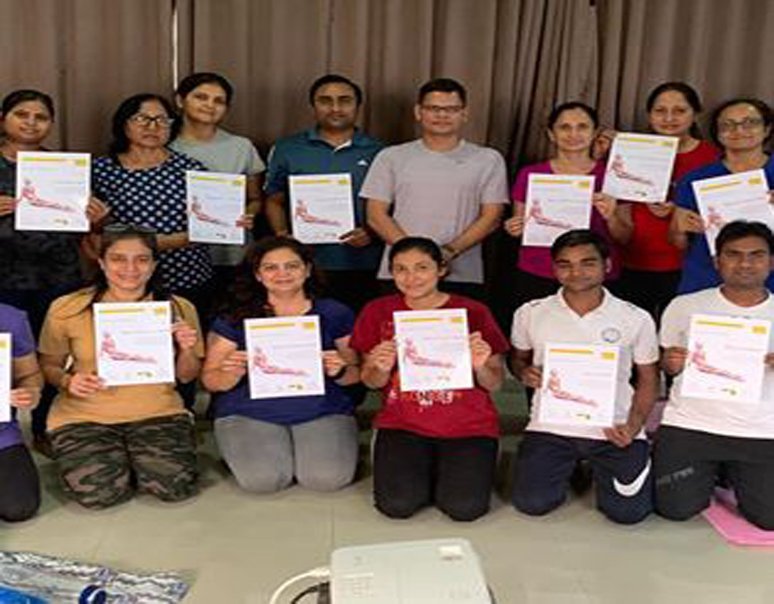
A structured teacher training curriculum changes this directly. Patanjali’s Yoga Sutras, the classical logic of pranayama sequencing, the biomechanics of how joint mechanics affect alignment choices — these are not additions to the practice. They are its foundation. Once you have access to them, every posture, every breath, and every moment of stillness you have ever experienced begins to make a different kind of sense. Practitioners who complete a serious training frequently describe their years of prior practice as something they can now read, rather than simply revisit. That shift, once it happens, does not reverse.
Will Your Personal Practice Actually Get Deeper — or Just More Technical?
This is one of the most honest questions a prospective student can ask, and it deserves a direct answer: both, and in that order.
There is a ceiling that personal practice hits when it is not accompanied by genuine understanding. You can attend class faithfully for years and still be practising from the surface — receiving real benefits, but not accessing the structure that makes those benefits reproducible, teachable, and progressively richer. Teacher training removes that ceiling, not by adding more poses to your repertoire, but by changing how you inhabit the ones you already know.
The immersive rhythm of structured learning — daily practice, supervised teaching, feedback from educators who are watching closely, philosophical study running alongside movement science — creates conditions for integration that drop-in classes simply cannot replicate. You stop doing yoga and start listening to it. Most students describe this shift as the single most unexpected gift of the entire training.
How Will Understanding the Body Change the Way You Teach — and Practice?
Here is the honest version of why anatomy matters: it is not about being able to name muscles. It is about being able to see what is happening in a human body and know what to do about it.
The ability to observe a student’s movement, identify compensatory patterns, recognise when an alignment cue is creating strain rather than resolving it, and adapt your instruction in real time — this is not a skill that develops through personal practice alone. It develops through study, and specifically through study that treats the body as a living, interconnected system rather than a set of parts to be memorised.
Ritesh Patel’s approach to anatomy — grounded in his academic background in Ayurvedic medicine and his MSc in Yoga Therapy from VYASA Bangalore — reflects exactly this. At LifeSpring Yoga, anatomy is not a chapter to be summarised. It is foundational to how every other subject in the curriculum is understood and applied.
What Does It Take to Feel Genuinely Ready to Teach — Not Just Certified?
There is a particular anxiety that many newly certified yoga teachers carry out of their training and into their first class: the gap between knowing and being ready. It shows up in the hesitation before a cue, the uncertainty when a student raises their hand with a question you weren’t taught to answer, the quiet voice after class that says — I need more.
That gap is not inevitable. It is the specific result of training programmes that prioritise content delivery over genuine preparation. Real readiness comes from having been taught how to see what is in front of you, how to listen carefully to what your students are telling you through their bodies, and how to respond to what is actually in the room rather than what you planned for.
Beyond the Qualification — How Does a Training Actually Change You as a Person?
This is the benefit that is hardest to explain to someone who has not yet experienced it, and the one that matters most to people who have.
Completing a yoga teacher training course changes how you relate to difficulty, to stillness, and to the quality of your own attention in ordinary life. This is not poetic language. The sustained pranayama practice, the philosophical study of how the mind generates its own turbulence, the daily rhythm of meditation and mindful movement — these have measurable effects on the nervous system. Cortisol levels drop. Heart rate variability improves. Activity in the prefrontal cortex — the region governing perspective and emotional regulation — increases. You do not simply learn more about yoga. You become, in a genuinely physiological sense, a calmer and more grounded version of yourself.
Ritesh Patel has designed the LifeSpring Yoga programme around this understanding from the beginning: that authentic teacher training must work on the whole person. Poonam Patel brings the same quality of presence to every learner in the programme, ensuring that the deeper dimensions of the process — the ones that don’t appear on a curriculum sheet but are felt in every session — are genuinely held.
Is the Investment Worth It — and What Do You Need to Know Before You Decide?
A completed yoga teacher training certification from a recognised institution with a serious curriculum opens professional pathways that personal practice alone cannot. This is not about the document itself. It is about the depth of knowledge the credential represents, and whether studios, wellness organisations, hospitals, and schools can trust what it signals about the person holding it. In 2026, that distinction matters considerably more than it did even a few years ago.
Whether you attend at the Vadodara studio or through the structured online programme, what a serious teacher training ultimately gives you is not a credential to add to a biography. It is a new understanding of why you have been practising all along — and the capacity, finally, to pass that understanding on.