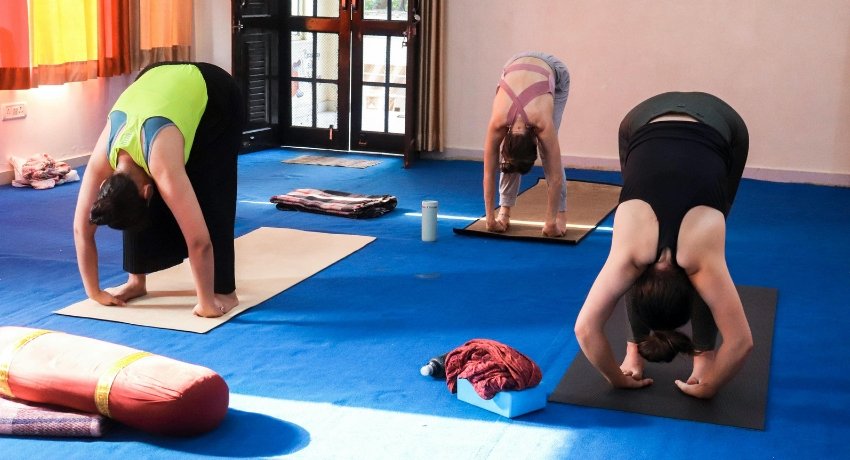
There is a moment that happens in almost every yoga teacher’s early career — a moment they rarely talk about openly. A student comes to class with a history of lower back pain, or a shoulder that has been surgically repaired, or knees that behave differently on each side of the body. The teacher cues the pose the way they were taught. Something goes wrong. Or nothing goes wrong that day, but it does three weeks later. And in that moment, the teacher realizes that knowing a sequence is not the same thing as understanding a body.
This gap — between knowing poses and understanding the human system that performs them — is one of the most significant structural problems in modern yoga education. And it is a gap that a genuinely anatomical approach to teaching can close.
The Insight That Changed a Teaching Philosophy
Dr. Ritesh Patel completed his yoga teacher training in 1999 and began taking sessions shortly after. In 2008, he enrolled in a gym instructor course — not because he was shifting directions, but because he was always expanding. What he encountered there stopped him mid-thought. Anatomy was being taught with a specificity and functional clarity he had not seen in yoga teacher training. His immediate question was: why aren’t yoga teachers learning this way?
That question became a commitment. He resolved that whenever he started his own teacher training program, anatomy would not be a module tucked into the schedule. It would be foundational. This was not an unfamiliar territory for him — his graduation had included the study of human anatomy with actual dissection, which gave him a direct, three-dimensional understanding of the body that most yoga educators never develop. Over the years that followed, he updated that foundation systematically through yogasana-specific anatomy workshops and the growing body of literature emerging at the intersection of movement science and yoga practice.
When he launched the Teacher Training Course at Life Spring Yoga Institute in Vadodara in 2012, anatomy was built into its core. What he observed over the years that followed confirmed the instinct: the difference in how teachers performed with and without anatomical knowledge was visible, consistent, and significant. As he reflects on it, it was not everything in yoga — but it was a major contributing factor and a fundamental one.
Why Anatomy Changes the Way You Cue
When a teacher understands connective tissue behavior, they stop applying uniform cues. They recognize that the instruction to “straighten your leg” in a forward fold is biomechanically different for someone with long femurs versus short ones, and that pushing a hamstring stretch beyond its current capacity does not accelerate progress — it triggers a protective contraction that does the opposite.
This is not esoteric knowledge. It is the basic science of how tissue responds to load and to threat. And yet it transforms teaching entirely. A teacher grounded in functional anatomy begins to observe before they instruct. They read weight distribution, joint angles, breath quality, and compensatory patterns before deciding what, if anything, to say.
The ripple effect extends to injury prevention — one of the most underweighted responsibilities in yoga education. Yoga-related injuries are not rare, and the majority trace to predictable causes: premature depth, uniform cueing across anatomically diverse students, and insufficient understanding of contraindications. A teacher who understands how hypermobility differs from flexibility, or how a chronically tilted pelvis changes the mechanics of virtually every standing pose, does not make these errors. Not because they are being careful — but because their understanding makes the right choice obvious.
Dr. Ritesh Patel’s dedicated workshop on functional anatomy of yogasana, and the parallel workshop on injury prevention in practice, reflect a conviction that these are not advanced topics for specialists. They are foundational competencies for anyone standing at the front of a yoga class.
The Nervous System Connection
Anatomical understanding in yoga education does not stop at the musculoskeletal system. Some of the most significant recent developments in understanding how yoga actually works — why it changes anxiety, sleep, pain sensitivity, and emotional regulation — come from research into the nervous system.
The vagus nerve, which runs from the brainstem through the thorax and into the abdomen, is increasingly understood as a primary pathway through which breath-based practices produce their systemic effects. Slow, diaphragmatic breathing activates vagal afferents that shift the autonomic balance away from sympathetic dominance. These are not metaphorical explanations — they are measurable physiological events.
Teaching this well requires understanding it anatomically. The diaphragm is not just a breathing muscle — it has fascial connections to the psoas, which attaches to the lumbar spine, which means chronic diaphragmatic restriction and chronic lumbar tension are often the same problem viewed from different angles. A teacher who understands this cues breathwork differently. They understand why releasing the psoas through certain supine positions can produce an emotional response in students, and they know how to hold that space appropriately.
What This Means for How Yoga Gets Transmitted
Mrs. Poonam Patel, who co-founded Life Spring Yoga Institute alongside Dr. Ritesh Patel, has contributed to building an environment in which this anatomically grounded philosophy is not siloed in one workshop. It threads through the full arc of the 300-hour yoga teacher training curriculum — from the way asana is introduced in early sessions to the clinical nuance of the yoga therapy components.
Anatomy cannot be taught effectively in isolation. It has to be encountered repeatedly, in different movement contexts, with different bodies, under the guidance of someone whose clinical work keeps that knowledge alive. That is how it moves from information into perception — the ability to actually see what is happening in a student’s body and make intelligent decisions about it.
Yoga education in 2026 is at an inflection point. The volume of available training has increased enormously. The average depth has not kept pace. Practitioners who want to teach well — not just teach — are drawn to programs where anatomy is treated as a serious, integrated discipline rather than a weeklong module.
If you are at that stage in your own development — where you sense that understanding the body more deeply would change everything about how you teach — that curiosity is worth following with the same seriousness you brought to your own practice.