Most people choosing a yoga teacher training course ask the wrong first question. They ask: Which course has the best reviews? Or: which one fits my schedule? These are practical considerations, but they skip something more fundamental — and that gap is exactly why so many people complete a certification and still feel unprepared to teach, or worse, unprepared to practice with real depth.
The right yoga teacher training course in Vadodara is not the one that looks most impressive on paper. It is the one that is built to change how you understand your own body, your breath, and your relationship to discipline. That is a different standard. And in 2026, with yoga certifications proliferating faster than ever through short online programs and weekend intensives, knowing how to apply that standard has become genuinely important.
What You Are Actually Choosing
When you select a yoga teacher training program, you are not only choosing a curriculum. You are choosing a pedagogical philosophy — a whole orientation toward what yoga is for, how it is transmitted, and what a teacher is responsible for.
This distinction gets lost in a market saturated with options. A 200-hour program over one month, delivered digitally, with minimal individual feedback, produces a very different outcome than a 300-hour program built around progressive learning, anatomy, breath science, and direct mentorship. Both issue certificates. Only one produces a teacher who can navigate the complexity of a real student’s body and nervous system.
In Vadodara, where traditional yoga education has maintained a seriousness that larger metro cities have gradually diluted, there are still institutions where this distinction is lived and not merely claimed. Dr. Ritesh Patel, founder of Life Spring Yoga Institute and a practitioner with over 21 years of experience in yoga education and yoga therapy, has spoken to this often in the context of how he structures training: the goal is not to produce certified teachers but to produce educators who genuinely understand what they are transmitting.
The Anatomy Question — and Why It Matters More Than You Think
One of the clearest ways to evaluate a yoga teacher training course is to look at how seriously it treats functional anatomy and injury science. This is not a supplementary topic. It is foundational.
The human musculoskeletal system, the breath mechanics that regulate the nervous system, the connective tissue behavior that changes how asanas should be cued for different bodies — these are not advanced subjects reserved for therapists. They are the basic competencies of anyone who intends to guide another person’s physical practice. And yet many programs treat anatomy as a checkbox rather than a core discipline.
Research into musculoskeletal injury in yoga practitioners consistently points to the same source: teachers who do not understand anatomical variation and who apply uniform cues across diverse bodies. The harm is real and preventable. What prevents it is thorough training under educators who have both the clinical background to understand these mechanisms and the teaching experience to convey them clearly.
Dr. Ritesh Patel’s academic background in Ayurvedic medicine, combined with his MSc in Yoga Therapy from VYASA Bangalore, gives his approach to anatomy a depth that is uncommon in standard teacher training environments. This is not incidental to the quality of education offered in Vadodara — it is foundational to it.
How Vadodara’s Learning Environment Changes What Is Possible
There is something worth understanding about choosing offline yoga teacher training in a city like Vadodara. The environment is not merely convenient — it is pedagogically significant.
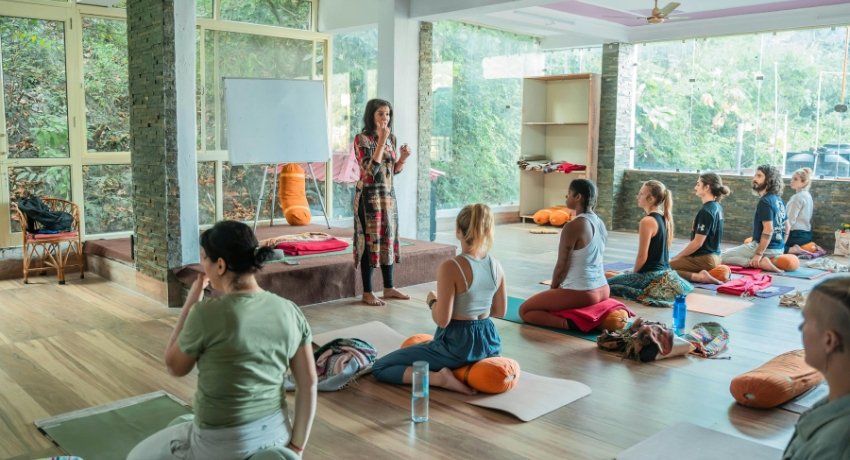
In-person training creates conditions for a quality of observation and correction that digital formats struggle to replicate. A teacher watching you breathe, watching your weight distribution shift in Trikonasana, watching the subtle signs of nervous system stress in your practice — that quality of attention requires physical presence. It is the difference between being instructed and being taught.
The offline learning culture that institutions like Life Spring Yoga Institute have cultivated over nearly two decades in Vadodara reflects an understanding of this. The physical space, the rhythm of daily practice, the presence of a teaching community — these are not extras. They are the containers in which real learning happens.
Mrs. Poonam Patel, co-founder of the institute, has long contributed to building this environment not just as a physical space but as a relational one — where students feel observed, supported, and held to a standard of practice that deepens over time.
The Global Accessibility Factor
Choosing the right course is not only relevant for those located in Vadodara. Increasingly, structured programs from established institutes are accessible to practitioners around the world through rigorous online certification formats.
This expansion matters — but so does the question of rigor. An online yoga teacher training course that maintains live interaction, individual feedback, progressive curriculum design, and genuine mentorship is a fundamentally different experience from a self-paced video library. In 2026, when attention is fragmented and digital fatigue is real, the structure of how you learn matters as much as the content itself.
Dr. Ritesh Patel’s international teaching work — including his roles as visiting faculty in Singapore and Vietnam — reflects a commitment to maintaining quality regardless of geography. That same sensibility shapes how online programs from Life Spring Yoga Institute are designed: not as a convenience offering, but as a carefully structured alternative for global learners who cannot attend in person.
The Questions to Ask Before You Commit
Before choosing any yoga teacher training course in Vadodara — or anywhere — consider these: How long has this program been running, and what do its graduates actually go on to do? Does the curriculum address breath physiology, anatomy, and injury prevention as core subjects? Is there direct mentorship, or only recorded content? Who are the lead educators, and what is the depth and breadth of their actual training?
These are not gatekeeping questions. They are the kind of clarity that separates a genuine learning investment from a credential purchase.
Yoga in 2026 does not need more teachers with certificates. It needs more practitioners with depth — people who have been trained rigorously, corrected with care, and equipped to pass on something real.