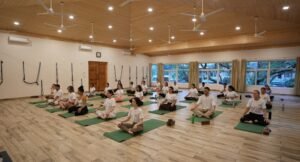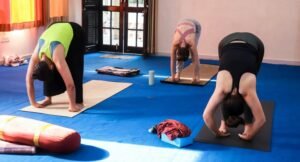
The certificate arrives. The hours are logged. The practicum is complete. And then, within the first few weeks of actually teaching, something quietly unsettling happens: the real world of yoga instruction looks almost nothing like the training room.
A student mentions a herniated disc and asks if they can still join the class. Someone breaks down unexpectedly in Savasana. A corporate wellness client wants a forty-five-minute session that addresses stress, improves focus, and ends with everyone feeling energised — in a conference room with no mats. A long-term practitioner signs up for your beginners’ course and sits in the front row, watching.
None of these scenarios were in the curriculum. And the graduate, certification in hand, is left navigating them on instinct — which is precisely the opposite of what training is supposed to produce.
This gap between certification and readiness is one of the most significant and least discussed problems in yoga education today. Understanding why it exists is the first step toward choosing a training that does not reproduce it.
The Problem With How Most Certifications Are Designed
Yoga teacher training programmes proliferated rapidly through the 2000s and 2010s as global demand for yoga instruction grew. The 200-hour certification became the industry standard — a minimum threshold established with reasonable intentions that has since, in many cases, become a floor that programme designers treat as a ceiling.
The structural problem is not the hour count. It is the orientation. Many certification programmes are designed primarily around content delivery — covering the required topics, completing the required hours, and producing graduates who can demonstrate basic competency in a controlled environment. What they are not designed around is the reality of teaching: the unpredictability of real students, the complexity of real bodies, the emotional and relational dimensions of holding space for human transformation.
Research in professional education consistently distinguishes between declarative knowledge — knowing that something is true — and procedural knowledge — knowing how to apply it under genuine conditions. Most yoga certifications are heavy on the former and thin on the latter. Graduates know the names of the muscles. They are far less prepared for the moment when a student’s hamstring does not behave the way the anatomy diagram suggested it would.
Why This Gap Has Widened in 2026
The wellness landscape of 2026 has made this preparedness gap more consequential than ever. Students arriving at yoga classes are not, by and large, arriving for recreation. They are arriving with chronic stress disorders, histories of physical injury, experiences of anxiety and depression, and a genuine — if sometimes unarticulated — hope that yoga might help them feel more whole.
The Global Wellness Institute’s recent research identifies yoga and mind-body practices as among the fastest-growing segments of preventive healthcare globally. In India specifically, the integration of yoga into public health frameworks — including national wellness initiatives and corporate health programmes — means that qualified yoga teachers are increasingly working in clinical-adjacent contexts that require a level of professional readiness that many certifications simply do not build.
A teacher who has learned poses but not people, who understands sequences but not nervous systems, who can lead a class but cannot adapt to what the room actually needs — that teacher is not ready for the world their students are living in.
The Four Gaps Most Certifications Leave Open
1. Nervous System Understanding
The physiological mechanism through which yoga produces its most significant benefits — regulation of the autonomic nervous system, reduction of cortisol, activation of parasympathetic responses via the vagus nerve — is both scientifically well-documented and largely absent from most certification curricula. A 2023 review in Frontiers in Psychiatry confirmed that structured yoga interventions produce measurable improvements in anxiety and stress outcomes, with effects linked specifically to nervous system regulation.
A teacher who does not understand this cannot use it deliberately. They are producing results they cannot explain, which means they cannot reliably reproduce or refine them.
2. Real Teaching Practice Under Supervision
Most certifications include a practicum component — a required number of supervised teaching hours. The critical word is supervised. In many programmes, supervision means an observer is technically present. In genuinely effective training, supervision means consistent, specific, expert feedback that helps the teacher develop real-time adaptability — the capacity to read a room, respond to what is happening, and make intelligent adjustments in the moment.
Educational research on skill acquisition is unequivocal: feedback quality, not hours logged, is the primary driver of teaching competence. A practicum without genuine mentorship is, at best, unsupervised practice.
3. Philosophical Grounding That Transfers to Real Life
Classical yogic philosophy — particularly the teachings of Patanjali’s Yoga Sutras and the broader tradition of Indian philosophical inquiry — is not supplementary content. It is the framework within which yoga teaching makes sense. Teachers who carry genuine philosophical grounding navigate the relational and ethical complexity of teaching with a coherence that cannot be replicated by technique alone.
When a student is distressed, when ethical questions arise in class, when a teacher is faced with their own limitations — philosophy is the resource that holds. Cursory exposure to philosophical content during a busy certification course does not create that resource. Deep, guided engagement does.
4. The Business and Professional Reality of Teaching
Most yoga certifications devote little or no serious time to what happens after graduation: how to communicate professional value, how to structure fees, how to navigate the real conditions of working in studios, corporate settings, or private practice. Teachers who graduate without this orientation often spend their first year in confusion about why genuine skill is not translating into a sustainable practice.
What to Look for in a Certification That Actually Prepares You
The distinction between certifications that genuinely prepare teachers and those that merely certify them comes down to a small number of critical factors.
Look for programmes where supervised teaching practice is genuinely mentored — where feedback is specific, consistent, and given by experienced educators who are actually watching closely. Look for curricula that include therapeutic application alongside technical instruction — where anatomy is taught in relation to real conditions, not as an isolated subject. Look for philosophical depth that is integrated into the entire programme, not confined to a module. And look for evidence that the programme’s graduates are actually teaching effectively — not simply that they completed the hours.
The learning environment matters as much as the curriculum itself. Immersive, studio-based training — where the practice, the teaching, and the mentorship exist in a shared physical space — creates conditions for integration that modular online courses, however well-designed, struggle to fully replicate. For those who cannot access in-person training, the quality of live interaction, feedback, and community in a structured online programme becomes the critical differentiator.
The Vision That Makes the Difference
Ritesh Patel’s approach to yoga teacher education is built on a foundational conviction: that preparing teachers for the real world requires designing training around the real world. This means building therapeutic literacy into the curriculum from the beginning, ensuring that supervised teaching practice involves genuine expert mentorship, and treating philosophical grounding not as content to be covered but as understanding to be developed.
Poonam Patel brings the same commitment to ensuring graduates leave prepared — not just certified. At the LifeSpring Yoga studio in Vadodara, Gujarat, this philosophy shapes every element of the learning environment. For those joining the structured online programme, the same standards of mentorship and curriculum depth are maintained across every module.
Who Needs to Read This
This is for anyone standing at the threshold of a yoga teacher training decision — wondering why programmes vary so dramatically in cost, structure, and reputation, and not quite sure what to look for. It is also for recently certified teachers who recognise themselves in the gaps described here, and who are wondering whether advanced training might give them what their foundational certification did not.
The answer to that question is almost always yes. The more useful question is where to find it.
Preparation Is Not a Luxury — It Is the Work
There is a version of yoga teacher training that produces graduates who are ready — not merely certified. Who can walk into a room full of real people with real bodies and real histories, and teach with genuine competence, adaptability, and care.
That version exists. It requires more from its designers and more from its students. But the teachers it produces carry something that no amount of additional certifications can retrofit: the confidence that comes from having been genuinely prepared.
That confidence is worth finding the right programme for. And taking the time to know the difference.